Our Expert Answers:
What is the GMAT Superscore and how does it work?
If you have retaken the GMAT exam, the Superscore combines your highest scores from the three exam sections into one "personal best" score across all test attempts.
Why is the GMAT Superscore important?
The GMAT Superscore will be included alongside the GMAT score(s) that you decide to send to schools. It may showcase better section results from other exams you've taken while also, for better or worse, revealing the dates of the other retakes.
It’s a bird, it’s a plane, it’s Superscore! Bursting onto the scene in August 2026, the GMAT Superscore shows potential to shake up the MBA admissions evaluation process – producing at least a tiny tremor if not a seismic shift.
What is a “superscore”? There are three sections in the GMAT exam: Quantitative Reasoning, Verbal Reasoning, and Data Insights. A superscore combines the highest score that you have gotten in each section into one – essentially, your personal best across all test attempts, while your Total Score reflects your overall performance on a single test day. The GMAT Superscore will be included alongside the GMAT score(s) that you choose to send to schools.
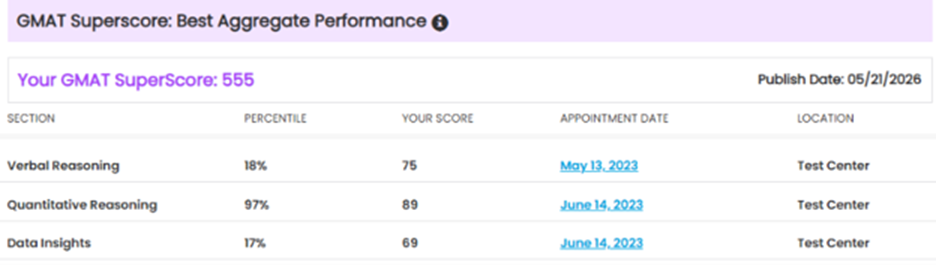
After you take your first exam, you will evaluate how you did, if you might have done better, whether you need to do better, and whether you have time to study and retake the exam. If you decide on a retake, you will then repeat the process until you give up or achieve an acceptable outcome.
“Very qualified candidates sometimes walk away from the testing process with less confidence than their abilities deserve, often because one section score or one testing experience doesn't tell the full story.” - Joy Jones, CEO of GMAC, maker of the GMAT exam
With the GMAT Superscore, every retake has both the potential to improve the single score you ultimately send to schools and/or pump up your Superscore.
MBA admissions committees focus on the highest score that is submitted, so most applicants proffer only their highest score, end of story. Many admissions committees attempt to get additional information, asking applicants to self-report all of their scores from every exam, or at minimum “How many times have you taken the exam?” Retaking the exam is not viewed as a negative in itself, and raising your score is a positive in the eyes of admissions committees. If provided with more than one score, the admissions officers can evaluate the progress that you’ve shown.
Now here comes the GMAT Superscore – faster than a speeding bullet, more powerful than a locomotive – to overturn your hesitation. You cannot opt out of sending the Superscore. For MBA admissions committees, the GMAT Superscore provides the X-ray vision into a more complete picture of your academic potential.
Wharton has long employed a super-score method, and will continue to do so, according to an online session with admissions officers held by the GMAC Club. Other schools that plan to begin using the Superscore as part of decision-making are Cornell Johnson Graduate School of Management, Yale School of Management, and London Business School. NYU Stern School of Business and MIT Sloan School of Management state that they will not consider the Superscore for the 2026-2027 admissions cycle (although Sloan admissions has been known to ask applicants directly if they’ve had a better quant score on a past exam, presumably because the one submitted was disappointing). Which other schools will incorporate the Superscore into their processes and which will decide not to make immediate changes will be revealed this fall.
Here are three common scenarios in which the GMAT Superscore could benefit an MBA applicant:
On the other hand, some applicants hope to avoid raising additional doubts about their academic capabilities and, given a choice, would probably still prefer to report just one score and one exam attempt. Here are two typical scenarios in which disclosing retakes (via the GMAT Superscore report) might disadvantage an MBA applicant:
Unless you achieved your best section scores in one exam, you will need to report 2-3 retakes based on the number that GMAT Superscore report reveals. I predict that many schools will also insist that you report the GMAT scores from each attempt exposed by the Superscore. (Schools already request that information, but again, applicants often just reported a single score.) While not an ideal situation, don’t stress too much – a less-than-optimal exam history isn’t Kryptonite to your application. Admissions officers are aware that people may lack the time and/or resources to prepare adequately over and over.
GMAT says that “repeat test taker data shows that retesting can boost your score by 20-30 points on average.” You can take the GMAT exam five times a year, and you could theoretically do so every year for the rest of your life. But don’t get carried away. Here are some facts that will bring you down to earth.
According to GMAC’s own data, the “20-30 points” statement overstates the results that they found (based on the older version of the GMAT – no data from the current version has yet been released).
A retake does not guarantee a score increase. Take time for serious preparation prior to your retake so that you can actually make some serious gains.
The GMAT Superscore, while a nice enhancement, will not be an earth-shaking game changer for most applicants. Business schools are not deciding who is accepted or not based on a couple of test points. Hopefully, your section scores are not wildly swinging up and down, which means that your GMAT Superscore will be hovering not far above your highest GMAT Total Score.
Let me present an unlikely scenario. First exam: You score in the top 99th percentile in one section, but crash & burn in the others. Retake: You now reach the top 99th percentiles in the other two sections but in the third section, where first you scored at the top, your score plummets to the 22nd percentile. You still land a 655 Total GMAT Score and a sky-high Superscore. Unfortunately for you, the admissions officers will look at both scores and have serious concerns about your erratic test-taking, knowledge gaps, or partial amnesia.
Back to reality: a score that is unbalanced between sections cannot be rescued even by a superior Superscore. If you hope that your Superscore can counter disastrous test performances in Quant, Verbal, or Data Insights, the Superscore will not save you.
As a flex, a business school often likes to boast of its incoming MBA class’s impressive test scores, be it the class mean score or median score. For example, if the class average score was 670 and the median score was 675, the school would likely spotlight the 675 in its Class Profile. A few schools, such as Chicago Booth, CMU Tepper, and UVA Darden, publish both the average and median, but most do not. (With the roll-out of the newest GMAT edition and its different scoring system, schools also publish averages or medians from both the old and new tests.)
Now the schools will have the opportunity to publicize the even higher GMAT Superscores. I expect that they will, because high scores enhance a school’s prestige.
I also predict that many applicants will end up confused. What is the “good GMAT score” that will get favorable attention from MBA admissions committees? What is the goal to strive for? Prior to the release of the newer GMAT, a stretch goal might fall in the score range of 720 to 740, but today it would be somewhere between 675 to 690 – in 2025, the highest incoming class average score was 690, held by Columbia Business School. Yet MBA program applicants still talk about chasing the 720.
With the rise of the GMAT Superscore, I predict that the public’s concept of a “good score” may soar into unrealism, especially if schools start to publish their Superscore averages.
I take this opportunity to remind you that the Superscore, however it may eventually be used, is an ideal. It was meant to reward you for trying to better your score, not set unrealistic expectations for admissions officers and applicants. That said – full speed ahead to reaching your own personal best!
Austin GMAT Review is the premier GMAT preparation company in Central Texas. With classes led by GMAT master teacher Dr. Amar, we offer strategic, expert guidance to help you attain an elite GMAT score. We cater to busy professionals who are aiming for top business schools, including professional assistance with putting together a great MBA application that will get you accepted.
If you seek top-notch expert help with the GRE test, we recommend our affiliate Austin Elite Prep for GRE preparation.